Current Immersive Documentary in Development – CLIMATE: VISUALIZING THE INVISIBLES
A starting note from R. Buckminster Fuller: “When I was born in 1895, reality was everything you could see, smell, touch and hear. The world was thought to be absolutely self-evident. When I was 3 years old, the electron was discovered. That was the first invisible. It didn’t get in any of the newspapers; (nobody thought that would be important!) Today 99.99% of everything that affects our lives cannot be detected by the human senses. We live in a world of invisibles.”
Quoted in the book “A Fuller Explanation: The Synergetic Geometry of R. Buckminster Fuller (Back-in-Action books)” by Amy C. Edmondson, J. Baldwin
This comment by Buckminster Fuller is part of the inspiration for this project.
CLIMATE: VISUALIZING THE INVISIBLES Logline: “In the midst of our intensifying climate crisis, this project will provide very usable visual tools for all of us to be able to ‘see’ the inner workings of our molecular atmosphere, from the macro to the micro, so we can reimagine how to make real world solutions and change our future. Even though we can’t see it, we are deeply a part of the air around us with every breath we take and every sound we hear. It is time to know our atmosphere as dense, complex, understandable, and repairable. Our very lives depend upon it.”
LINK to extensive STATEMENT OF PLANS Overview on CLIMATE: VISUALIZING THE INVISIBLES

Webpage Table of Contents Section Anchor Links: Research Grant Funding; Mind Map; 4 Climate Solutions Documentaries Pitch Deck; Manifesto; Research Books/Background; Whiteboard Ideas and Storyboard Sketch samples; Information about Immersive Dome Screens; Test Designs Work in Progress; Powers of Ten visual scaling device; Edward R. Tufte’s book VISUAL EXPLANATIONS; TROPICAL RAINFOREST Immersive Main Opening Title in 32 world languages; VISUALIZING SUSTAINABILITY Prototype Title Design in 28 world languages; SEEING AIR FLOW/TURBULENCE AROUND CARS; Scaling the same images on screens; 3,500 Dome Theaters World-Wide; EXPLODING THE FRAME: Seeking a New Cinematic Language; Wall Street Journal TROPICAL RAINFOREST immersive documentary review; IMMERSIVE DOME IMAX MOVIE REVIEWS; METERKID: SCALING THE SOLAR SYSTEM; Shedd Productions, Inc. Manifesto; TED NTU talk 2018 MY 180° View – Our World of Opposites.
University Research Grant Funding for CLIMATE: VISUALIZING THE INVISIBLES Research, Scripting, and Early Designs

Mind Map of Connected Ideas for Climate Solutions Documentaries Link To Full Size MindMap

4 Climate Solutions Documentaries Link to video Pitch Deck funding proposal.

CLIMATE Seeing The Invisibles Manifesto. Link to Full Size Mind Map

CLIMATE: VISUALIZING THE INVISIBLES Research Books/Background & Air/Water Comparison Density Example
A few of the 900+ Climate and Molecular Biology research books gathered for this project. And a direct demonstration of the density and fluidity of the atmosphere compared to the density and fluidity of water. Carefully put one’s hand out a moving car window to directly feel the thickness of the air. Click on images to see larger details. Link to extensive collection of selected short sections from Climate and Molecular Biology Research books – 154 page PDF collected during reading and research for CLIMATE: Visualizing the Invisibles.


Here is one of many, many book excerpts driving the production of CLIMATE: VISUALIZING THE INVISIBLES: from the book “Your Atomic Self: The Invisible Elements That Connect You to Everything Else in the Universe” by Curt Stager
“When viewed from a great distance the sky resembles a shockingly thin film, and most of its molecules are packed into a mere ten-mile slice of a total planetary diameter of nearly eight thousand miles. At sea level you might find more than ten trillion trillion atoms in a cubic yard of air, but just outside that vaporous skin is the relative vacuum of the solar system, in which fewer than a dozen atoms might enter each of your lungs should you try—and fail—to breathe out there. The next time you see a photo of the earth taken from space, try to convince yourself that a pollutant-spewing smokestack anywhere in the world doesn’t unleash potentially harmful substances into the same precious air supply that keeps you and your loved ones alive.”
And this invisible detail from YOUR ATOMIC SELF, which we will visualize to be unforgettable: “It is still easy to overlook, for example, as Priestley and Becher did, the increase in total mass that fire produces in burning fuel, because the buoyancy and dispersal of the waste gases conceals it. Burning a six-pound gallon of gasoline releases about nineteen pounds of heat-trapping carbon dioxide into the atmosphere, and the U.S. Energy Information Administration estimates that transportation vehicles in the United States alone released more than a billion and a half metric tons of CO2 in 2012. Such perceptual limitations can make it difficult to notice our effects on our surroundings, and they can sometimes mislead us about the atomic nature of the air we breathe.“
And in his book And in his book DEEP FUTURE: THE NEXT 100,000 YEARS OF LIFE ON EARTH Prof Stager writes: “Artificial greenhouse gases are as real and present in our daily lives as the Anthropocene is…If they were large enough to be seen with the unaided eye, it would be impossible for anyone to ignore them.”
A Key Project Goal for CLIMATE: VISUALIZING THE INVISIBLES is to make those “ten trillion trillion atoms in [every] cubic yard of air” and the mixing multiple of carbon exhaust with oxygen in the air into something we can all see in our imaginations as real vivid things we swim through and breath every moment of every day, and imagine and “see” all of the CO2, just a tiny but important part of our atmosphere, grabbing invisible infrared light, which is heat and which is warming our planet, at a speed way out of scale with the two billion years of our planet’s 4.5 billon years it took our planet to be a livable place for us and every living thing on Earth. This immersive work will make it so we can all see and imagine “with our unaided eyes.”
Additional Research Background: Attending the 1997 UN KYOTO Protocol Conference in Japan with a Press Pass to research climate and the planet. Meeting with the late Climate Scientist Stephen Schneider [Part of the IPPC Group receiving the Nobel Peace Prize and one of the scientists I featured in the 1975 NOVA Program THE SUNSPOT MYSTERY], and he was an acquaintance for many years. A key Stephen Schneider Book which influenced this research is: LABORATORY EARTH: The Planetary Gamble We Can’t Afford To Lose [published 1996].

CLIMATE: VISUALIZING THE INVISIBLES Whiteboard Ideas and Storyboard Sketch samples


CLIMATE Visualizing the Invisibles White board notes 3


Information about Immersive Dome Screens, from IMAXDomes to University Display Walls and Domes in classrooms. One of the formats for CLIMATE: VISUALIZING THE INVISIBLES
Using Ben Shedd’s EXPLODING THE FRAME immersive image design template and teaching EXPLODING THE FRAME in dome and display wall classroom settings. Click on images to see larger details.


CLIMATE/KLIMATE/VISUALIZING THE INVISIBLES Test Designs Work in Progress:
MindMap Collection Sketches for Rainbow Colored Hexagon Scale Containers, for providing animated comparative size relationships from the whole universe down to molecules and atomic scale in an immersive environment. Seeing multiple scales of size from the macro to the micro at the same time – powers of ten side-by-side, using rainbow colored hexagon templates. Click on images to see larger details. Immersive Dome Player software for developing and testing immersive placement and experience of immersive environments. [The full MindMap file is too large to upload for this website. Available on request.]


Visualizing the scale of our invisible physical world – Powers of Ten visual scaling device
Visualizing the scale of our physical world using rainbow colored hexagon frames as scale memory device, to show side-by-side simultaneous images of the same thing at several orders of magnitude, using microscopic and electron microscopy imagery in parallel with human scale. Animation prototype in third image. Click for animation.


Click above for movie animation test on immersive Dome testing Amateras Dome formatting software, showing rainbow hexagon frames with different scalar physical magnifications. These are “hexagon flowers” of histories of weather and climate, bursting from the center out, with shared content in each flower.
Guidelines for presenting and visualizing factual materials and imagery with accuracy, excerpt from Edward R. Tufte’s book VISUAL EXPLANATIONS.
Ben Shedd taught with this book for 6 years as main textbook in Princeton University Department of Computer Science course he created, using their experimental immersive Digital Display Wall. The screen was 18ft/5.5m by 6ft/1.8m multi-projector blended wall and original CS research in creating interconnected PCs into a computer cluster which we have everywhere now – the display wall was just a way to look at the computer process and Ben Shedd saw a mini immersive IMAX like screen to propose a class in immersive image making and design. The course was titled “Visual and Audio Design for Large-Scale Computer Displays”, using the EXPLODING THE FRAME research as the foundation for teaching effective giant screen immersive design.


Digital Display Wall & first class Princeton University Department of Computer Science
TROPICAL RAINFOREST Immersive Main Opening Title in many languages, for world-wide media markets. Created 1992.
Sample of a giant dome screen immersive title, presented in 32 languages, for huge visual immersive screens, presented with a waterfall of voices saying all of these phrases from around the planet. Translations and Voice provided by United Nations Member States. For international distribution.

TROPICAL RAINFOREST 4K Digital Remaster from IMAX Dome Film. Created for the Science Museum of Minnesota & IMAX Theaters in Science Museums around the planet. 1992 Funded by the John D. and Katherine T. MacArthur Foundation, the National Science Foundation, and the SMM Production Fund. A Shedd Productions, Inc. Film. Ran continuously on one IMAX DOME screen after another around the planet for 9.5 years.
LINK: TROPICAL RAINFOREST – 38 minutes -Vimeo link: https://vimeo.com/489251668 PassWord: TROPRain2020MP4
Two links to essays about making TROPICAL RAINFOREST: Behind The Scenes: https://benshedd.com/tropical-rainforest-behind-the-scenes-notes-by-ben-shedd/ & Science Content Scrip Synopsis: https://benshedd.com/tropical-rainforest-science-content-script-synopsis/
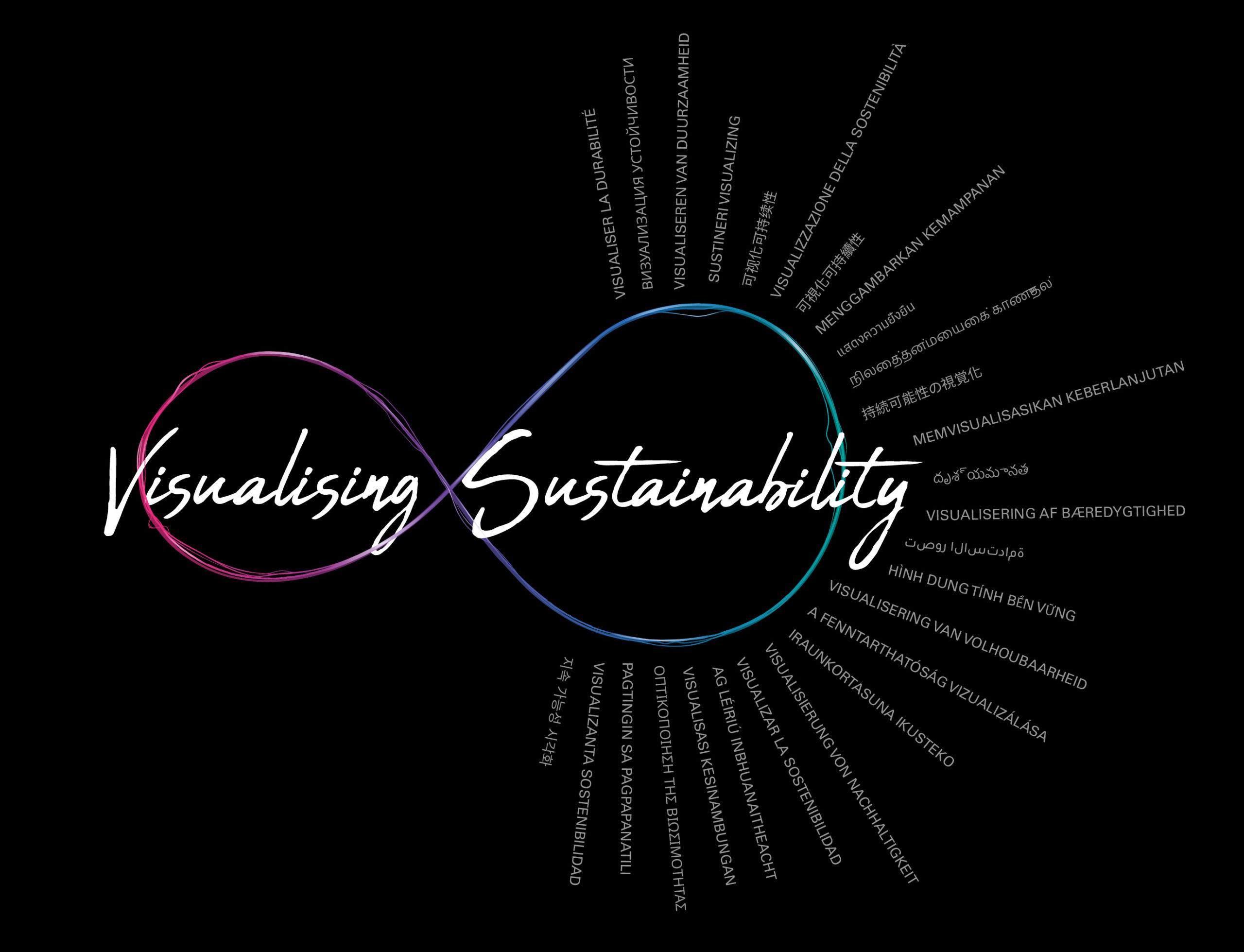
VISUALIZING SUSTAINABILITY Prototype Title Design in 28 world languages. — For international distribution
Sample of giant dome screen immersive title, prototype design.

SEEING AIR FLOW/TURBULENCE AROUND CARS
Photos of cars showing the flowing patterns of the thickness of our invisible air, our atmosphere, scraping the paint off cars, from driving in New Mexico’s nearly invisible gritted hot sunny air, pushing turbulence from our dense air/atmosphere over every moving car [a wonderful lab for observations]. The movement of the dense swirling air pushed aside while driving is clearly seen from the worn paint patterns on the hoods of many cars, making the invisible visible. Air pressure at 7,000ft elevation in New Mexico is 11.34 pounds per square inch. 12 inches by 12 inches of air pressure, 1 square foot is 144 square inches which equals 1,632 pounds per square foot or 8/10ths of a ton of air pressure per square foot pushing inward, on every square foot of a moving car. Imagining the invisible air patterns show where the air pressure needs to be pushed aside for each of us to drive our cars, and this requires using fuel, either fossil fuels or electricity, to push aside the invisible atmosphere. The more efficient the design of our cars for air flow and reduced drag [like the red and grey EV-1 cars shown in the second row, still the best designed car for low drag to date*], the less disruptive drag down at the molecular level…. *Designed by Gossamer Condor designer Paul MacCready and team for General Motors.


Imagine thick dense invisible air divided into two flowing swirling vortices over the hood of this car.
Aerodynamics of drag animated on/around racing and sports cars.


Aerodynamic Design video at this link.


Sample of Scaling the same images on screens to be appropriate for the different size screens where we view content.


3,500 Dome Theaters World-Wide from FullDome Data Base website https://fddb.org See “Venues” in “Community” menu on website for international locations of immersive dome screens

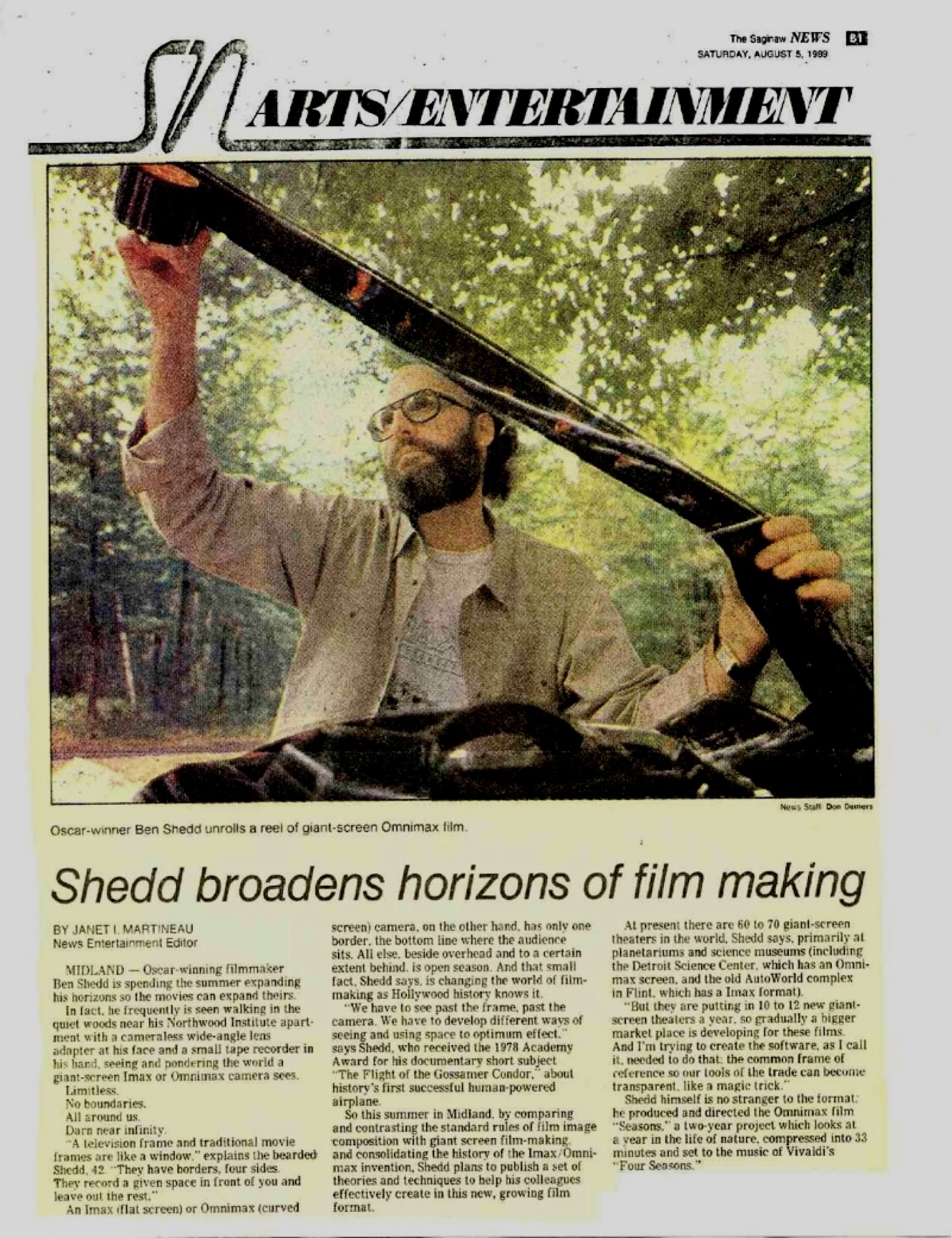
EXPLODING THE FRAME: Seeking a New Cinematic Language. Alden B. Dow Creativity Center 1989 Creativity Fellowship. Creativity Fellowship Goal: Research and compare the similarities and differences of the cinematic language used in small framed screen productions and giant immersive screen productions.
Fellowship for 10 weeks – and continuing to this day – Researched and Developed a large body of fundamental ideas, a new cinematic language, for working in immersive media/screen space, under the title EXPLODING THE FRAME.

White Papers and Presentations about making effective science topic immersive Dome Documentaries: POTENTIALS FOR EXPANDING SCIENCE LITERACY WITH GIANT SCREEN IMMERSIVE DOME FILMS and DESIGNING EFFECTIVE GIANT SCREEN IMMERSIVE FILMS
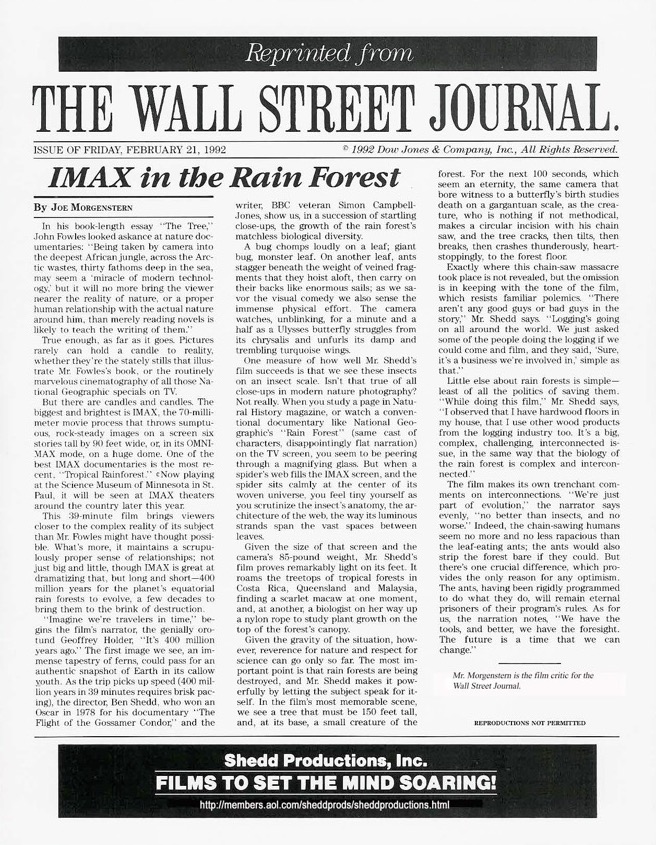
TROPICAL RAINFOREST immersive documentary review by Joe Morgenstern in the Wall Street Journal 1992

IMMERSIVE DOME IMAX MOVIE REVIEWS FOR SEASONS, FORT WORTH FLYOVER II & TROPICAL RAINFOREST Directed, Designed and Co-Produced by Ben Shedd
Click for larger version or expand this PDF to full screen to read.
Another Immersive project in development: METERKID: SCALING THE SOLAR SYSTEM, using the height of a 6-7 year kid who is about a meter tall – METERKID – to measure the distances from Earth to the Moon, all the planets, and the sun. Script and Storyboard completed, linked below.

METERKID: Scaling the Solar System Immersive Dome Script.
METERKID Immersive Dome Storyboard.
Last, but perhaps first is Shedd Productions, Inc. Manifesto, with a detailed creative working overview of how we approach the films and videos, large screen and small screen, we make —

And one more note: How I approach ideas to make the strange familiar and the familiar strange. TED/NTU talk 2018.
